

Average Dies First. Judgment Doesn’t.
A $20 AI tool, thirty years of pattern recognition, and the color that almost shipped wrong.

A confession about color palette
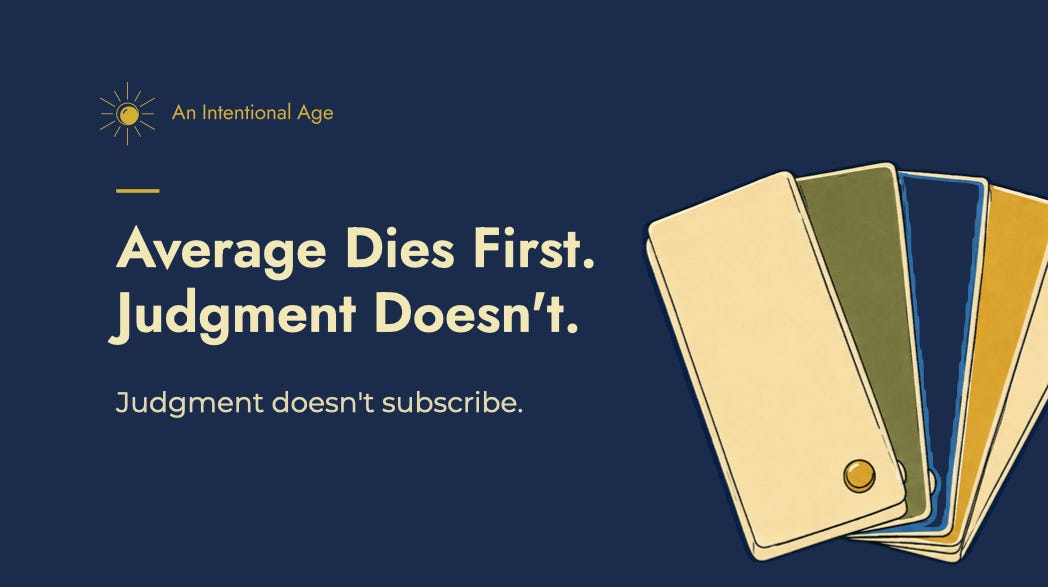
A few weeks ago I confirmed the color palette for An Intentional Age. Cosmic Navy. Sidecar Beige. Earthrise Aqua. Lunar Gold. A small slice of Mod Orange for the action moments. It’s called Apollo Horizon.
It’s not the palette I started with.
For about a month, I worked with Sage Green, Soft Cream, and Warm Terracotta. I shipped a quote card with those colors in March. It was fine. People liked it. I was unsatisfied.
Here’s what I didn’t tell anyone until this paragraph: the old palette had been making me low-grade uncomfortable that whole time. I kept rendering mockups, scrolling them on my phone, and feeling something that wasn’t quite right. Couldn’t name it. The kind of nag you carry around at my age when your gut is talking faster than your vocabulary.
Then a couple of weeks ago I sat at my desk with two pieces of work open — a Canva mockup beside a quote card I’d rendered in Claude — and the wrongness clicked.
Sage plus Cream plus Terracotta. I had built a wellness consultant 2018 palette and almost shipped it under my own name.
The old colors were speaking the wrong language. They didn’t capture the present-day urgency of the AI transformational moment. They also didn’t reach into the visual memory my audience actually lives inside. Late sixties. Early seventies. Apollo era. Moon-landing summers in someone’s living room, the foil on the lunar lander, the photograph called Earthrise that changed how a generation thought about our place in the universe.
The new palette does both. Cosmic Navy is the night sky over Florida in 1969. Sidecar Beige is the kitchen counter in the house your grandmother lived in. Lunar Gold is the foil. Earthrise Aqua is the photograph.
Apollo Horizon is a peer-level nod. It says: I remember that era too. And it has to feel like the present and striving forward, because that’s the work.
What just happened in that decision
The taste came from thirty years of looking at brand systems. Recognizing Sage + Cream + Terracotta as wellness-consultant-2018 requires having looked at thousands of brand systems. AI couldn’t have told me that. A junior designer couldn’t have either, not because they lack ability but because they haven’t yet seen the same pattern enough times to feel sick about it.
What AI did was let me iterate at a speed I couldn’t have matched alone. I tested twelve directions in an afternoon. Sidecar Beige itself came out of a conversation with Claude about the actual paint chips of mid-century American interiors.
A junior designer with the same tool would have shipped a different palette. Probably a clean one. Probably one I’d seen before.
Apollo Horizon needed both the taste and the tool. The taste without the tool is a brand still sitting in my head five years from now. The tool without the taste is another beige-and-blue logo that thinks it’s about wellness.
One decision. One palette. Multiply that move by every domain you’ve spent thirty years inside, and you have the rest of this essay.
The visible story
You’ve probably seen the chart this week. UK tech graduate roles down forty-six percent last year. US entry-level software and data postings down sixty-seven percent. Junior jobs are getting hollowed out fast. The fear is grounded. The data is real.
I’m not going to soften any of that.
What I am going to do is point at the other story running underneath, because that’s where you and I actually live.
The numbers no one is putting on the chart
About a third of senior developers, ten or more years into their careers, say over half their shipped code is AI-generated. The number for juniors? Thirteen percent. Senior developers are shipping AI-generated code at roughly two and a half times the rate of juniors. Not because they’re more technical. Because they can tell when the AI is wrong before they ship it.
Klarna spent two years replacing about seven hundred customer-service jobs with AI. In spring 2025 the company reversed course and started hiring humans again. The CEO publicly admitted they’d gone too far on the quality drop. Duolingo’s CEO walked back his “AI-first” stance the same year. IBM announced this February that they’re tripling entry-level hiring in 2026, after a year of AI-driven HR cuts. Their HR chief was direct about why: the companies skipping entry-level hiring now will be poaching mid-level talent from competitors in three to five years, at much higher cost.
The market is correcting itself in real time.
Not because AI failed. Because experience compounds with AI faster than inexperience does with the same tool.
Average dies first because average can be subscribed to for twenty dollars a month. Judgment doesn’t, because judgment is what AI can’t replicate. Pattern recognition built from reps. Scars. Failed launches. Sitting in chairs you’ve sat in for decades.
The operator differential
The same $20 AI subscription, in the hands of someone twenty years your junior, produces average output. In your hands, it produces decisions worth six figures.
The tool is identical. The operator isn’t.
This is the part that gets misread. People hear “AI is going to take your job” and assume the AI is doing the work. The AI is not doing the work. The AI is multiplying whoever is directing it. Right now, the person with thirty years of judgment plus a $20 tool is competing against the person with three years of judgment plus a $20 tool. That math is not subtle. You can see it in the senior-developer numbers. You can see it in the IBM reversal. You can see it in Klarna’s re-hiring.
You are inside that correction window right now.
Read with me!
The trap
Here’s the warning. The temptation in an essay like this is to leave you feeling validated.
The danger isn’t that your experience doesn’t matter. The danger is taking comfort in knowing it matters and never deploying it.
Wisdom in a drawer is worth zero subscription dollars.
Crystallized intelligence sitting in a sixty-one-year-old who refuses to open Claude is, economically, indistinguishable from the same kind of intelligence sitting in a thirty-year-old who hasn’t yet lived it. Both produce nothing. Both compete for the same average output. Both lose to the operator who actually showed up.
Apollo Horizon doesn’t ship if I don’t open the tool. Thirty years of brand-system pattern recognition produces zero unless it meets a $20 subscription this week.
You grew up watching the moon landings. So did I. We have the receipts. We also have a closing window of operator advantage. Maybe twenty-four months. Maybe thirty-six. Until the people two decades behind us catch up on both fluencies.
One specific thing to do this weekend
Not next quarter. This Saturday or Sunday morning.
Sit down with paper or a document open and write a one-page description of how you make decisions in your area of expertise. The rules of thumb. The patterns you look for first. The things you check before anything else. The signals that tell you a project is in trouble. The questions you ask when something feels off.
Don’t try to be comprehensive. Don’t try to make it good. Make it specific. Write the way you’d talk to someone shadowing you for a day.
Then take one real piece of work you’re doing this week. A strategy document. A client-call prep. A board memo. Whatever it actually is. Upload your decision-rules document to Claude or ChatGPT alongside that piece of work and ask the tool to apply your rules to it. Read what comes back.
Notice what changes. Notice what the AI catches that you’d missed because you were too close to it. Notice what it suggests that you’d never approve, and what that tells you about your taste.
That’s the move. The operator advantage made tangible in one weekend.
What the market is wrong about
I built Apollo Horizon by doing the same exercise in a different domain. The palette I almost shipped wasn’t bad. It was average. Average is what a $20 tool produces when no one directs it. Average is what the market is about to be tired of, right around the time most of us are deciding whether to spend the next twenty years pretending AI isn’t here.
The market is telling you what it values right now.
The market is wrong about exactly one thing — who actually carries that value.
That’s the part you get to correct.