

When Clarity Doesn’t Come First
A confession, on my birthday, from someone who almost talked himself out of this

I’m writing this from my kids’ house in Maple Valley on my 62nd birthday.
There are stuffed animals on the floor. A mini soccer ball wedged against the couch. Tiny cars lined up along the baseboard with the kind of precision that only a three-year-old takes seriously. My granddaughter is napping. My grandson is at preschool. My adult kids are working upstairs. Julie is in the other room, laughing on the phone with family.
And I’m here, laptop open, doing the thing I’ve been circling around for a long time.
This is what I’ve been building toward. Not a beach somewhere. Not a finish line. This: working from anywhere, on my own terms, present for the people who matter most, still doing work that gives me purpose. All of it, simultaneously, on a Tuesday in May.
I didn’t believe, at one time, I could have this.
If this is the kind of honest conversation you've been looking for, this is the right place. New pieces every week.
The Pattern That Kept Winning
I’ve tried building something of my own before. Several times.
Most times started the same way. Real clarity. Real momentum. A version of myself I genuinely liked showing up. And then, somewhere in the middle of some, quietly, the wheels came off.
For years I blamed the circumstances. Wrong timing. Wrong market. Wrong phase of the economy.
The truth I’ve had to sit with: the pattern had a driver, and it was me.
Specifically, a brain that loves starting and struggles to sustain. Self-doubt that arrives with uncanny timing, right when something is actually working. The particular talent of ADHD for making the interesting thing suddenly feel impossible and the impossible thing suddenly feel urgent.
And underneath all of it, a fear I’ve only recently learned to name out loud: I didn’t believe I could build a financial life, at 62, that supported everything we’d worked for. The lifestyle. The freedom. The security Julie and I have been building together in our years together.
That fear is specific and real. I’m naming it here because I think you know it too. It doesn’t announce itself dramatically. It just quietly narrows every decision until you find yourself playing it safe and calling it strategy.
It almost won again this time.
The Room Where Things Shifted
Earlier this year I was in a room with thousands of people doing the kind of work that actually breaks patterns.
I’ve written about what happened there in another piece, specifically about bringing an AI thinking partner into a Tony Robbins event and what that combination produced. So I won’t retell it here. But the short version: I saw my limiting beliefs for what they were. Not cautious wisdom. Not personality traits. Old habits wearing a convincing disguise.
And habits can be rewritten.
What I walked away with wasn’t a motivational high. Those fade by Wednesday, in my experience. It was something more durable: a different relationship with my own self-doubt. Less “this is a stop sign” and more “there you are again. I see you. I’m going anyway.”
That’s still a daily practice. I’d be lying if I said it isn’t.
But something else happened too, something I didn’t plan for. I started writing, really writing, for people navigating what I was navigating. And the responses told me something I needed to hear: this resonates. You’re not alone in these questions. There’s a community waiting for this conversation.
Doors started opening that I hadn’t knocked on. That part still surprises me.
What I Couldn’t See Alone
Here’s something I’ve never said out loud before.
The times I actually succeeded in building something weren’t the times I went alone. A bed and breakfast venture in 2000 worked because I had a real partner beside me. Earlier in my career, the work that gained traction had the same quality: someone else in the room, thinking with me.
The solo attempts? Different story. Every time.
I told myself the circumstances were wrong. The timing. The market. But I’ve wondered lately whether the missing ingredient was simpler and harder to admit than any of that.
I didn’t have anyone to think with.
A solopreneur in 2000 didn’t have AI. Nobody did. You either had a business partner, a mentor, a spouse willing to sit across the kitchen table at 11 PM and push back on your thinking, or you didn’t. And when I didn’t, I was alone with my own blind spots. Which, as it turns out, are considerable.
What’s different now isn’t just the counter-programming or the growing audience or the doors opening unexpectedly.
It’s that for the first time, I have a thinking partner.
That partner is AI. And I want to tell you what it actually did, because it wasn’t what I expected.
I fed it my career history the way most of us describe ourselves: a list of companies and titles across four decades. Then I asked it to look for the pattern underneath. Not what I’d done. What I was actually doing in every chapter when I was most alive in the work.
What came back stopped me.
The thread wasn’t marketing. Not technology. Not even leadership, though those were all there.
It was teaching.
Every role at its best had been some version of helping people learn something and then use it. Not just understand it. Activate it. The facilitation work where I watched something genuinely click for someone. The learning design where the real measure was behavior change, not completion. The mentoring relationships where I helped someone see their own capabilities more clearly than they could alone.
I’d called myself a Learner for years because that’s what the assessment said. But that was only half of it. What I actually am is an applied learner. Someone who learns in order to activate, who activates in order to maximize.
The AI didn’t give me that. My own history did.
It just helped me read what I was too close to see.
Try this before you close this tab:
Open a conversation with Claude or ChatGPT. Describe your career, not the titles, but what you were actually doing when you were most alive in the work. Then ask: “What pattern runs through all of this?”
Push on what comes back. The conversation gets more useful the more honestly you show up to it. You have decades of data. This is just a way to finally read it.
This is what An Intentional Age is built for. Practical tools and honest conversation for people designing their third act. Subscribe to get each piece as it publishes.
The Throughline
That conversation changed everything.
Suddenly An Intentional Age wasn’t a content business that also did coaching. It was the fullest expression of who I’ve been my entire career: someone who helps people learn something real about themselves or their business, activate what they discover, and design to actually reflect it.
The teaching framework for the cohort. The reason AI fluency matters to this audience. The reason purpose and design aren’t soft concepts to me but structural ones. The reason I’d been building toward this without quite knowing it for years.
Everything had a spine.
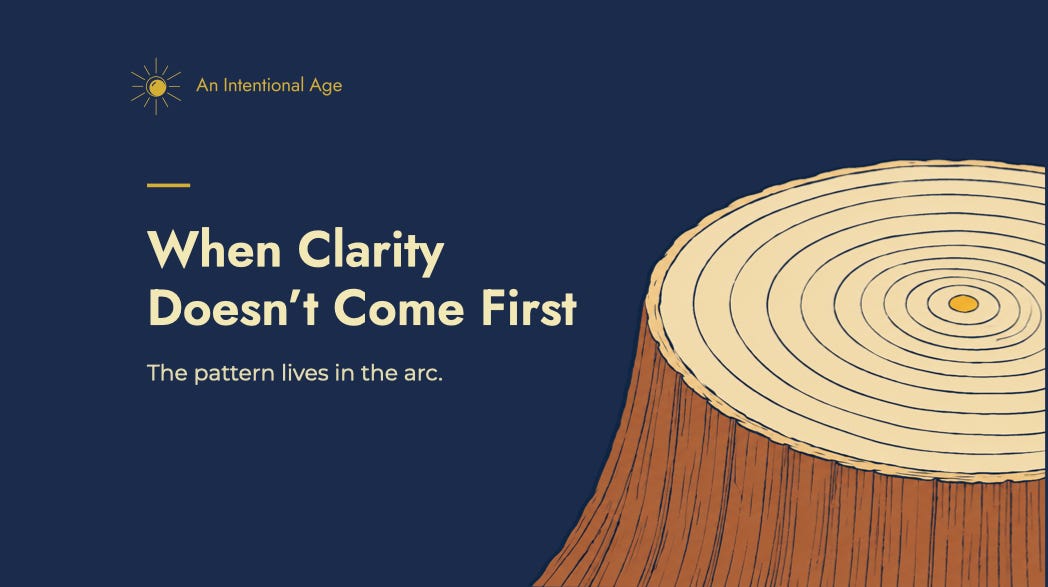
I couldn’t have seen that alone. Not from lack of self-awareness. We are all too close to our own history to read it clearly. We see the chapters. The pattern lives in the arc.
Why I’m Done Waiting
I’m 62 years old, sitting in a house full of toy cars, surrounded by evidence of a life that matters.
And I’m finally honest about what the waiting was.
It wasn’t strategy. It wasn’t wisdom. It was the same fear that has always talked me out of things, wearing a more sophisticated disguise. Dressed up as prudence. Calling itself being realistic.
The counter-programming is working. Not completely. I still feel the fear on hard mornings. But the cost of waiting has become impossible to ignore. Every month I delay is a month without this. The flexibility. The presence. The work that has a shape I actually chose.
So here’s the smallest thing I’m asking of you today. Not a grand challenge. Just a practical starting point:
Name the thing you’ve been circling. Not in your head. Write it down. One sentence: what is the specific thing you keep almost starting?
Then ask yourself honestly: is what’s stopping you a good reason, or is it a habit with a very convincing disguise?
You don’t have to answer that today. But you do have to ask it.
An Intentional Age is for people who refuse to drift through their third act. For the curious, the restless, the still-becoming. For anyone who wants to stay vital, deeply connected, and the author of their own next chapter.
I’ll write about using AI as a thinking partner, designing your life after the title goes away, and the grief nobody names when you leave behind who you used to be. I’ll share the hard parts, because you deserve honesty more than you need inspiration.
One last thing, from this birthday desk in Maple Valley:
What’s your throughline?
Not the titles. The pattern. What were you actually doing in every chapter when you were most alive? Try a little AI exploration of you to find it.
Hit reply and tell me. I’m genuinely asking.
—Bennie
An Intentional Age | anintentionalage.com
If this resonated, two ways to stay connected: